In the metal processing industry, high speed slitting lines enable the precise longitudinal cutting of strip materials and are widely used for the fine processing of various metal coils, such as steel sheets, aluminum sheets, and stainless steel strips.
Compared to standard metal coil slitting machines, high speed coil slitting machines can reach operating speeds of up to 230 m/min.
While this exceptional efficiency significantly boosts production line capacity, it also imposes rigorous demands on the equipment's tension control capabilities. During continuous high-speed operation, the strip remains in rapid motion; even minute tension deviations can be quickly amplified, directly leading to quality issues such as strip wandering, tensile deformation, uneven edges, and loose winding.
Therefore, precise, stable, and dynamic tension control technology is the core foundation for ensuring processing accuracy, product quality stability, and efficient production.
Stable and controllable tension ensures the strip remains precisely aligned with the cutter shaft, prevents deviations during high-speed operation, strictly maintains product width tolerances, and guarantees consistent quality across every batch.
Furthermore, high-performance tension control systems for high speed slitting lines can intelligently and dynamically adjust tension based on different production stages and material characteristics, perfectly adapting to diverse production conditions.
|
Tension control directly determines the quality of the slit strips and the operational stability of the equipment. High speed coil slitting machines equipped with precise tension controllers can optimize production outcomes, reduce costs, and extend equipment service life from multiple perspectives. Regarding product quality, precise tension control effectively prevents issues such as strip stretching, wrinkling, and wandering during high-speed slitting. It ensures accurate strip width and smooth, clean cut edges—free from defects like burrs or collapsed edges—thereby completely resolving problems related to out-of-tolerance product widths.
Regarding production losses, stable tension significantly reduces material scrap and the need to rework defective products caused by tension irregularities, effectively minimizing raw material waste and improving material utilization rates. Regarding equipment operation and maintenance, consistent and stable tension output prevents sudden load spikes on transmission components, cutter shafts, and winding/unwinding mechanisms. This reduces equipment wear and the frequency of breakdowns, significantly extending the overall service life of the high speed slitting line. Regarding finished coil winding, uniform and stable tension ensures tight winding, close interlayer adhesion, and neat, flat end faces. This eliminates issues such as loose coils, telescoping, and ridging, thereby guaranteeing consistent rewinding quality.
Leveraging mature tension control technology, KINGREAL STEEL SLITTER high speed coil slitting machines fully accommodate the processing needs of metal coils ranging from thin sheets to medium and heavy plates. By matching specific tension control strategies to different thicknesses and materials, the system maximizes production efficiency while ensuring stable product quality. |
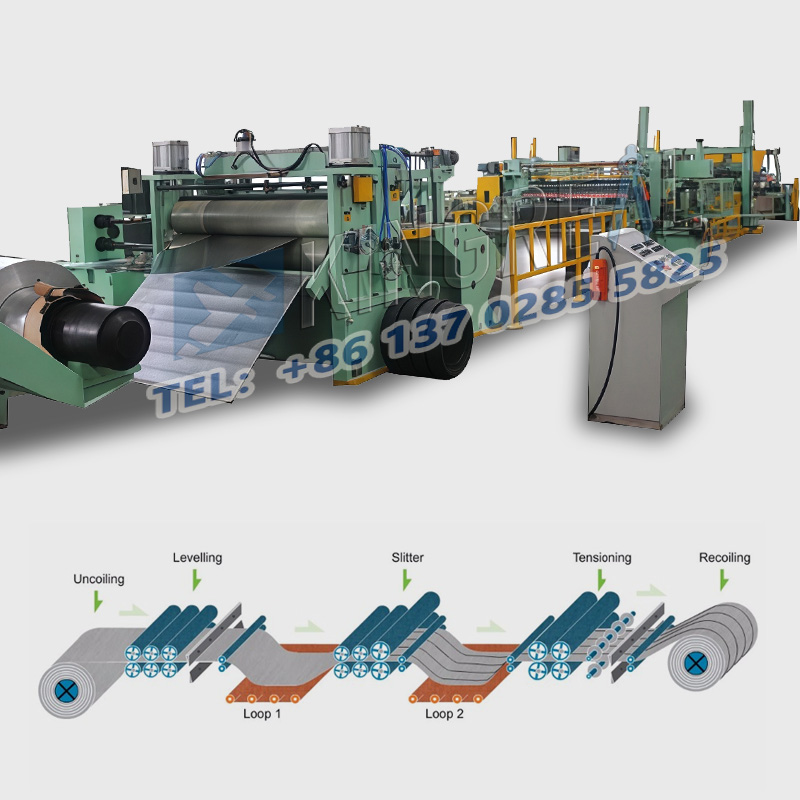 |
The complete operation of a high speed coil slitting machine comprises three core stages: uncoiling, slitting, and recoiling. These stages are tightly integrated and highly interdependent; tension fluctuations in any single stage rapidly propagate through the entire production line, ultimately compromising the quality of the finished product.
First, tension deviations caused by dynamic changes in coil diameter.
During uncoiling, material is continuously fed out, causing the coil diameter to shrink; conversely, during recoiling, the finished coil grows as material is wound. With constant equipment torque output, these dynamic diameter changes directly cause continuous fluctuations in strip tension. Without real-time dynamic adjustment, issues arise—such as excessive tension during the final stages of uncoiling or insufficient tension during the final stages of recoiling—leading to strip stretching, deformation, or loose winding.
Second, sudden tension changes caused by high-speed inertial impact.
High speed slitting lines operate dynamically, involving frequent high-speed starts, stops, acceleration, and deceleration; the rapidly moving strip possesses significant kinetic inertia.
During transitions in operating conditions, inertial forces trigger abrupt spikes or drops in tension. Excessive tension can snap thin strips, while insufficient tension causes slack, accumulation, or tracking errors, severely undermining slitting precision and production continuity.
Third, adaptation challenges arising from material property variations.
Different metal coils exhibit vast differences in physical properties—such as elastic modulus, elongation, and hardness—resulting in widely varying sensitivities to tension.
For instance, thin sheets are highly flexible and prone to stretching, requiring a control mode characterized by low tension and stable fluctuation management; conversely, thick plates are hard and rigid, necessitating high tension and highly stable control parameters.
If a high speed coil slitting machine uses uniform tension parameters to process different materials, quality defects are highly likely to occur.
Fourth, tension fluctuations caused by external operating conditions.
In actual production, external factors—such as uneven raw material thickness, mechanical equipment vibration, clearance deviations in transmission components, and ambient temperature fluctuations—can disrupt the operational stability of the high speed slitting line.
These factors trigger real-time fluctuations in strip tension; failure to compensate or adjust for these in a timely manner directly impacts slitting precision and the consistency of the finished product.
 |
 |
I. Tension Detection Technology
Precise tension detection is the prerequisite for closed-loop tension control in high speed coil slitting machines; only by capturing strip tension data in real-time and with high accuracy can the system obtain the data support needed for subsequent dynamic adjustments. Currently, tension detection methods for high speed slitting lines fall into two main categories—direct detection and indirect detection—to suit varying production precision requirements.
II. Closed-Loop Control System Architecture
Modern, high-end high speed coil slitting machines utilize an integrated closed-loop tension control system comprising detection units, controllers, and actuators. This system enables real-time correction of tension deviations and dynamic adjustments, effectively resolving tension fluctuation issues during high-speed operation.
The core control unit employs a dedicated tension controller, industrial PLC, or servo drive; it processes tension data captured by sensors at high speed using optimized intelligent PID algorithms, compares this data against preset process parameters, and outputs precise adjustment commands.
III. Material Property Adaptive Technology
To meet the processing requirements for metal coils of various materials and specifications, high-end high speed slitting lines are equipped with adaptive control systems for material properties. These systems enable intelligent parameter adaptation, overcoming the challenge where a single set of parameters cannot accommodate the processing of diverse materials.
The system features multiple built-in, specialized tension curves; operators can select the corresponding tension process parameters with a single click based on material type—such as thin sheets, medium-thick plates, or thick plates—to rapidly align with production conditions.
Additionally, the high speed coil slitting machine includes a self-learning mode that autonomously optimizes and corrects PID control parameters through repeated test runs, automatically adapting to inherent issues such as variations in material elasticity and uneven thickness.
For more information on precision tension control technology for high speed slitting lines , equipment specifications, and customized production solutions, please contact KINGREAL STEEL SLITTER directly for professional consultation.