In the metal processing industry, the precision of a metal coil slitting machine often hinges on a minute detail: the blade clearance. Blade clearance is one of the most critical adjustment parameters in the slitting process, directly influencing slitting accuracy, tool longevity, and production efficiency.
However, due to the stringent adjustment requirements and inherent operational risks, this task is both a routine maintenance procedure and a common source of malfunctions.
This guide, prepared by KINGREAL STEEL SLITTER technical experts, outlines the professional procedure for adjusting slitting blade clearance to ensure safe and efficient production.
Why is Blade Clearance Adjustment Crucial?
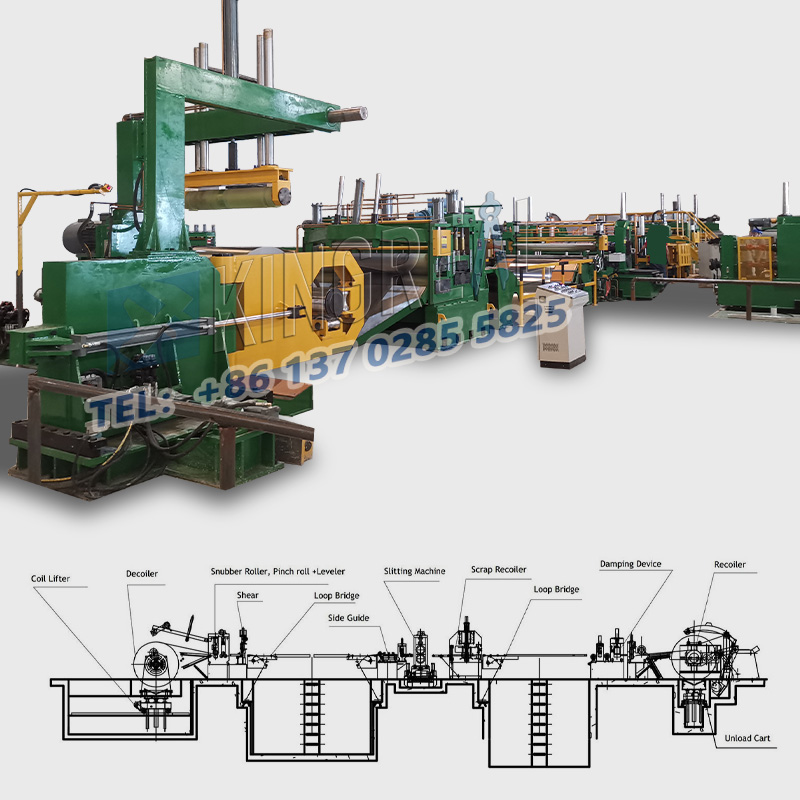
The function of a metal coil slitting line is to precisely slit wide coils into narrower finished strips. The blade clearance setting directly determines:
|
Slitting accuracy: Ensuring the finished strip width meets target specifications. Edge quality: Preventing excessive burrs or fracture zones. Equipment lifespan: Avoiding blade chipping or excessive wear caused by interference. Excessive clearance: The material is torn rather than sheared, resulting in severe burrs at the cut edge. Insufficient clearance: Significantly increases frictional heat, leading to blade damage and potentially overloading the machine, causing malfunctions. |
 |
Basic Principles of Slitting
|
Metal slitting utilizes a rotary shearing method, achieved through the coordinated action of upper and lower circular blades. Two core parameters must be mastered during adjustment:
Lateral Clearance: The horizontal distance between the upper and lower blades. The optimal value depends on the material's tensile strength and thickness. Overlap: The vertical depth of overlap between the upper and lower blades.
Only when lateral clearance and overlap are properly coordinated can a controlled fracture be created in the material, resulting in a smooth, perpendicular cut surface. |
 |
Specific Steps for Adjusting Blade Clearance
Currently, mainstream high-precision metal coil slitting machines use a combination of precision shims and spacers to accurately control clearance.
Please follow these five steps:
Step 1: Equipment preparation and safety check
Safety is the top priority. Always perform operations with the power disconnected and ensure a skilled technician is present to supervise. Thoroughly clean the cutter shafts and knives, removing metal chips, oil, or impurities.
Select a baseline value from the clearance parameter chart provided by KINGREAL STEEL SLITTER based on the material type and thickness of the coil to be processed.
Step 2: Theoretical Spacing Calculation
For shear-type slitting, the formula for theoretical spacing (S) is: S = Target Width (W) + Knife Thickness (t) - Overlap (Δ).
Note: The overlap (Δ) is typically set to approximately 15% of the material thickness. Use a micrometer or spacing gauge to precisely measure the actual distance between adjacent knives.
Step 3: Spacer Selection and Knife Installation
Select precision spacers of the appropriate thickness based on the calculation results and install them on both sides of the cutter shafts and knives.
Installation sequence: Install knives starting from the outer side of the shaft and moving inward.
Locking force: Use a torque wrench to ensure uniform tightening force. The standard torque for slitter knife nuts is typically around 150 N·m.
Feeler gauge check: Insert a feeler gauge from the side to measure the clearance; a slight resistance should be felt—it should be neither too loose nor forced in.
Step 4: Trial Cut Verification
Perform a trial cut on a small sample of material before commencing full-scale production. Measure the width of the slit strips using a digital caliper.
Width too large: Slightly reduce the lateral spacing.
Width too small: Slightly increase the lateral spacing. Repeat the trial cut until tolerance requirements are met.
Step 5: Parameter Locking and Recording
Once confirmed correct, fully lock all knives in place. Record the parameters (material type, thickness, width, clearance, overlap) in the production log. Establishing a parameter database will significantly reduce setup and adjustment time for future runs of similar specifications.
Diagnosis of Common Edge Quality Issues
Improper clearance settings typically manifest as the following defects:
|
Phenomenon |
Cause |
Consequence |
|
Serrated cross-section / Double fracture |
Clearance too small |
Excessive shear zone; blurred separation line on the cross-section; frequent knife chipping. |
|
Severe burrs / Tearing |
Clearance too large |
Misalignment of cutting edges; material is torn; excessive load placed on knife edges. |
|
Wavy edges |
Excessive overlap |
Material deformation caused by excessive vertical pressure; check if the stripper ring specifications are correct. |
|
Strip camber (lateral curvature) |
Uneven side clearance |
If the horizontal clearance between the blade sets is unbalanced, the strip will curve to one side. |
Mastering blade clearance adjustment for metal coil slitting machines is key to reducing scrap rates and maximizing return on investment.
After you purchase the metal coil slitting line, KINGREAL STEEL SLITTER provides comprehensive on-site training, covering blade changing, precise clearance adjustment, and routine maintenance.
We do more than just supply metal coil slitting machine; we are committed to ensuring stable production and the competitiveness of your finished products.
If you have any operational questions, please contact KINGREAL STEEL SLITTER after-sales technical team promptly.