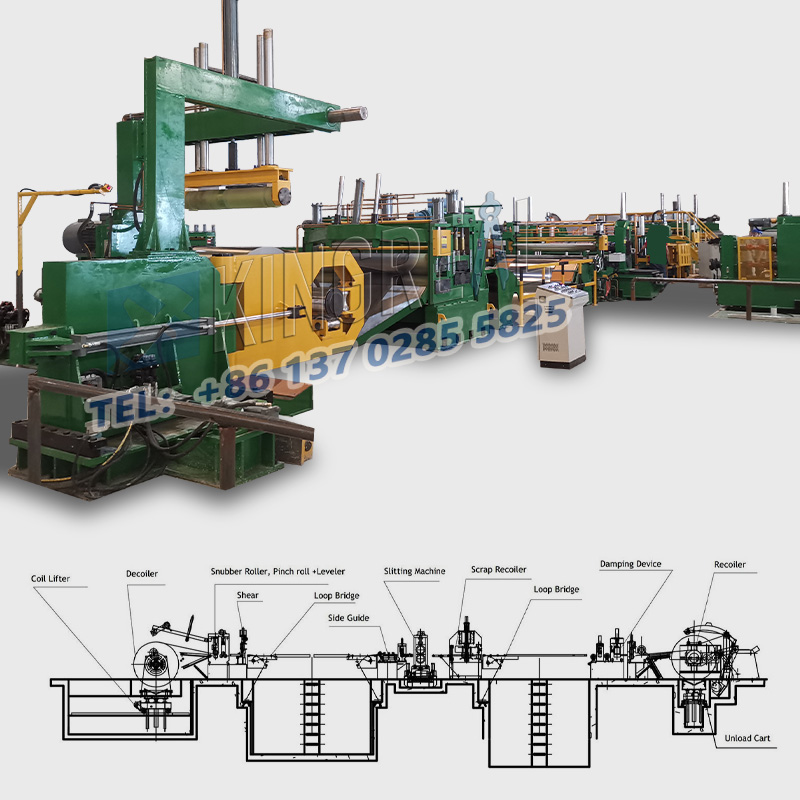
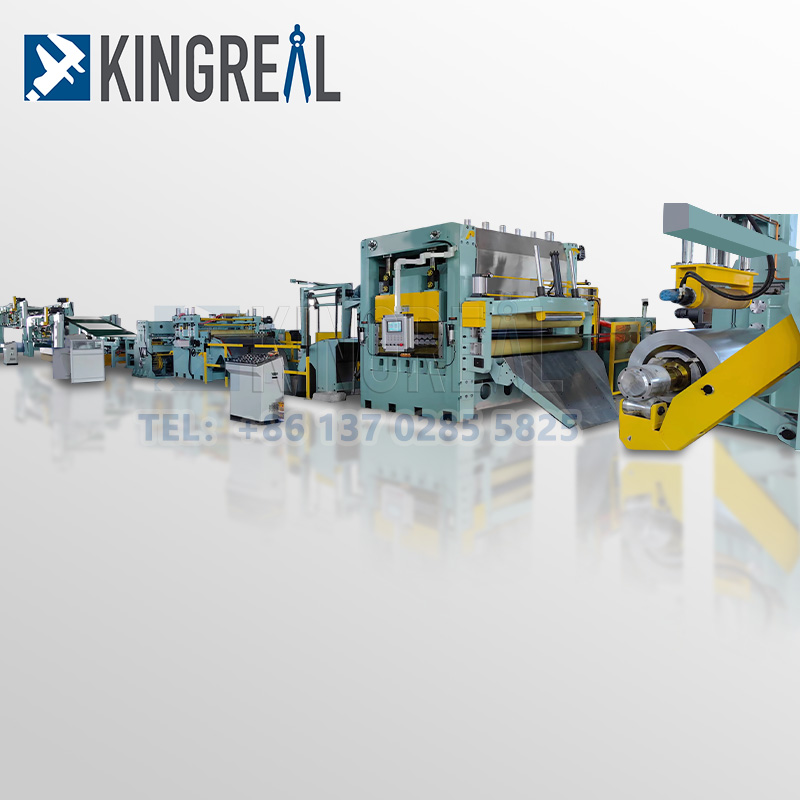
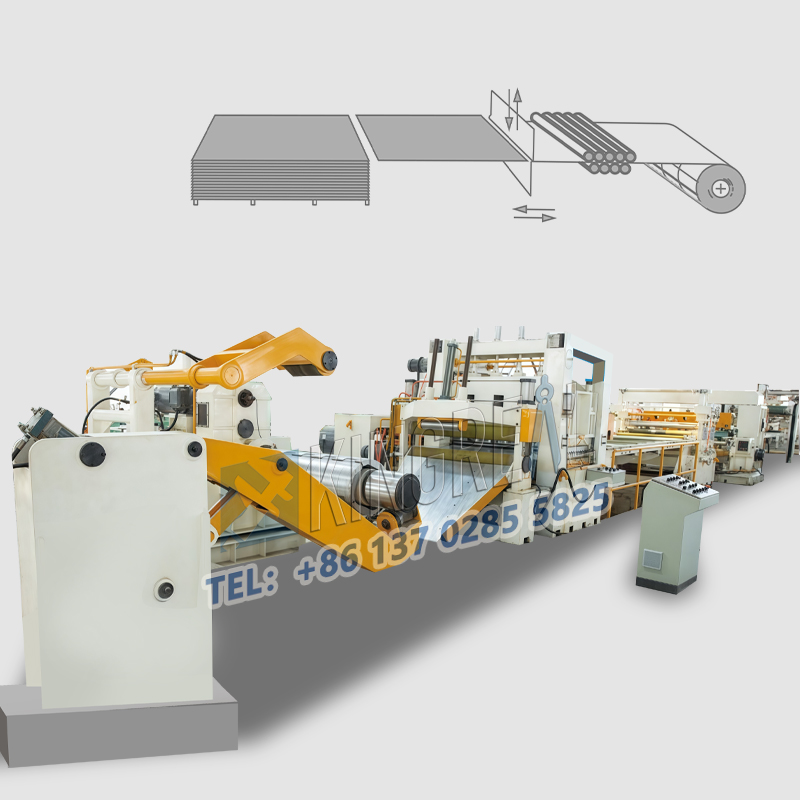
Compact cut to length machines and simple coil slitting machines are both important coil processing equipment designed to provide convenience for customers with small production scales and limited factory space. However, many newcomers to the industry often cannot distinguish between these two types of equipment, nor do they understand the differences between them and standard cut to length machines and coil slitting machines. This article will provide a detailed analysis of the characteristics and applications of these two machines to help you make an informed choice.
●Functions of simple coil slitting machine and compact cut to length machine
The main function of coil slitting machines and cut to length machines is to cut raw materials longitudinally and transversely according to the customer's actual needs, preparing them for subsequent forming processes. Longitudinal cut materials are typically used in applications requiring continuous production, such as automated stamping and rolling; while transverse cut materials are generally used for single forming processes, such as sheet metal stamping, bending, and stretch forming.
Compared to compact cut to length machines, simple coil slitting machines have a more streamlined design. Its working width is generally below 800mm, the material thickness it processes is between 0.5mm and 2mm, the allowable sheet strength is σs < 300MPa, the load-bearing capacity is below 5 tons, and the production speed is approximately 40m/min. These design features allow for simplification, but as the width and thickness of the material increase, the safety factor of the equipment also needs to be significantly improved, making simplified design more difficult.
●Flexibility and Complexity of Compact Cut to Length Machine
Compared to the simple design of a simple coil slitting machine, a compact cut to length machine exhibits significant diversity. Its feeding system, shearing, and subsequent stacking systems can be combined in various ways to meet different needs, and there is no unified standard for the overall form of the equipment. Therefore, understanding the inherent relationships between the various related devices is one of the keys to mastering the configuration of a compact cut to length machine.
Thinking of the entire cut to length machine as a regular metal stamping line helps to better understand its function. Unlike metal stamping lines where many materials do not require straightening, cut to length machines generally require straightening, which determines the value of its equipment configuration. The cut-to-length machine can be viewed as a punch press, while the shears are similar to a die. The configuration of a compact cut to length machine involves several basic conditions, which will be analyzed below.
●Material loading & straightening system of compact cut to length machine
The material loading and straightening system of a compact cut to length machine will vary depending on the customer's materials. Similar to conventional metal stamping lines, separate equipment or a combination of two (such as GO, ML, CL, TGL, etc.) can be selected. The material loading section selects the machine model based on the material width and inner/outer diameter, the pressing method based on the material thickness, and the power output and extension method based on the load capacity. The selection of the straightening section depends on the material thickness, speed requirements, and the customer's flatness requirements.
●Feeding system of compact cut to length machine
The feeding system of a compact cut to length machine will vary depending on the customer's requirements for sheet metal length and efficiency. Based on the power source, the feeding system can be divided into AC frequency converter length control, DC motor length control, and servo motor length control. For construction-grade cross-cutting with poor quality and large length tolerance requirements, a circuit combining a straightening power source, a frequency converter, and a length encoder can be used directly for length control. For materials with higher requirements, servo motor length control should be selected.
●Shearing methods of compact cut to length machine
Shearing systems can be categorized into built-in plate shears, purchased mechanical (hydraulic) shears, and pneumatic high-speed shears. For low-volume production, plate shears can be used directly. However, for compact cut to length machines with a wider and thicker range, purchased mechanical shears are more suitable. For applications requiring higher shearing speeds and precision, pneumatic or hydraulic high-speed shears should be selected.
●Collection methods of compact cut to length machine
The collection method depends entirely on the characteristics of the compact cut to length machine required by the customer. Optional manual collection, simple lifting collection, and automatic stacking collection methods further enhance the flexibility of compact cut to length machines. For compact cut to length machines producing thinner materials and shorter cut lengths, manual collection is more suitable; while for cut to length machines with longer cut lengths, lifting forklifts can be used for fixed-length collection. Automatic stacking collection is more suitable for mass production.
Design of Compact Cut to Length Machine & Simple Coil Slitting Machine and Customer Needs
The design of simple coil slitting machines and compact cut to length machines is based on the principle of retaining the basic functions of the corresponding production line, especially for compact cut to length machines. Different combinations can meet the needs of various production types. Similar to metal stamping lines, compact cut to length machines require optimal configuration based on customer needs. Understanding the customer's true purchasing objectives is fundamental to equipment configuration; without detailed customer information, even if the technical team can provide a solution, the likelihood of success will be significantly reduced.
In summary, when selecting equipment, whether a compact cut to length machine or a simple coil slitting machine, customers should comprehensively consider production needs, costs, and future development. A thorough understanding of customer needs will help maximize equipment effectiveness and improve production efficiency. KINGREAL STEEL SLITTER hopes this article provides valuable reference and advice for selecting suitable coil processing equipment.