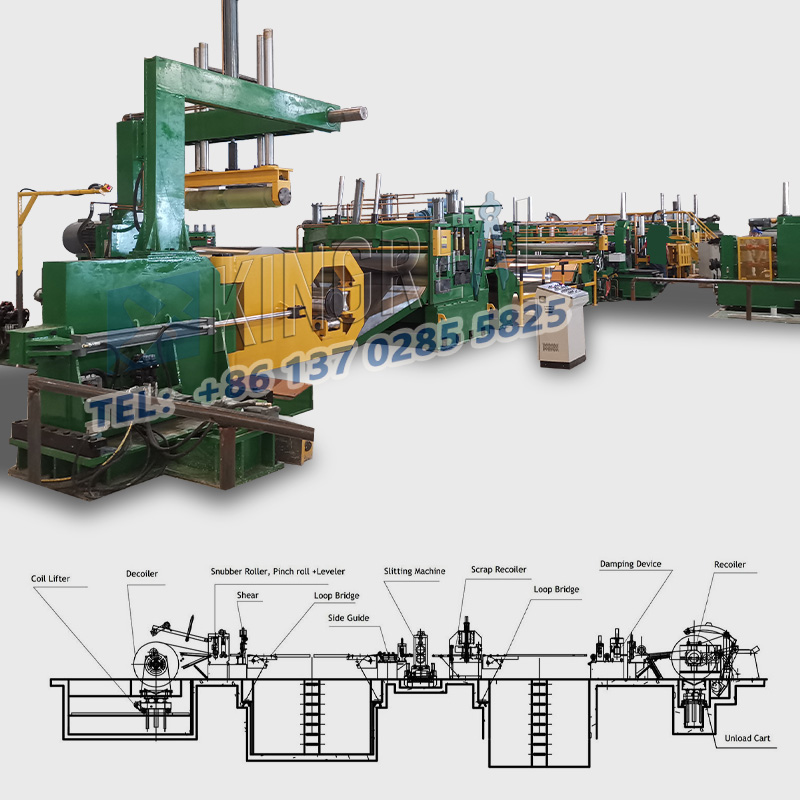
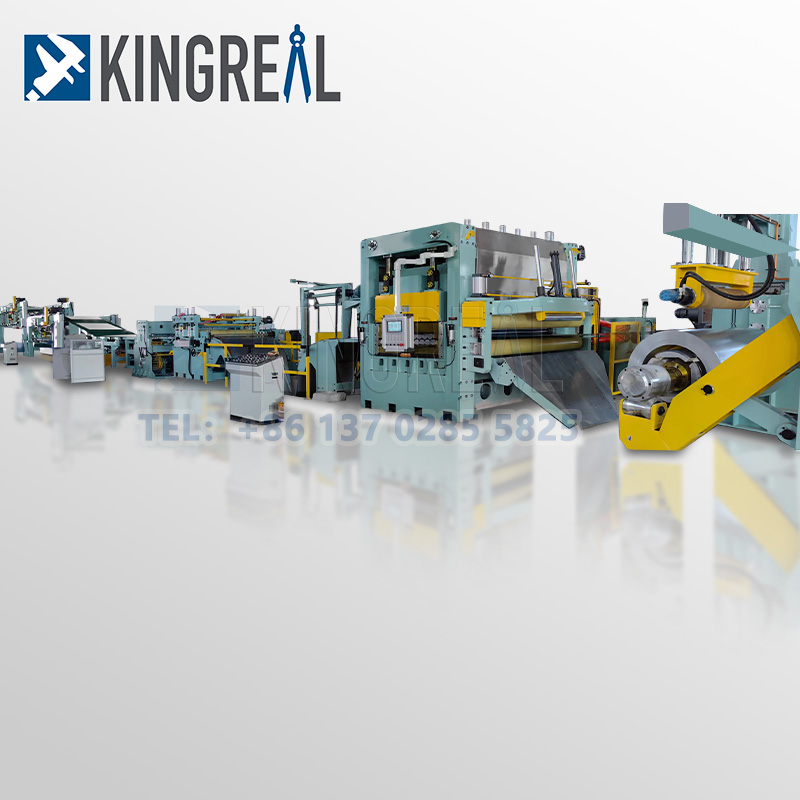
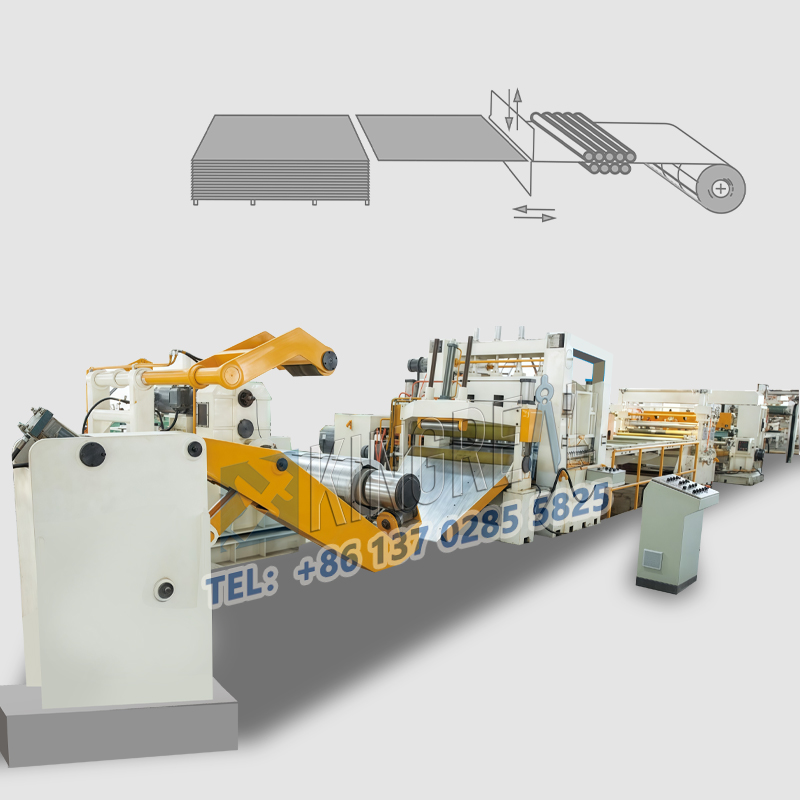
A heavy gauge cut-to-length line is specifically designed for processing thick-gauge metal coils, capable of handling steel coils and other metal materials with thicknesses of up to 25 mm. Compared to standard cut-to-length lines, a heavy gauge cut to length line requires greater structural rigidity, higher shearing capacity, and more stable material transport control to ensure that flatness, length precision, and surface quality remain within controlled parameters during the processing of thick plates.
A complete heavy duty cut-to-length line typically consists of a coil loading trolley, an uncoiler, a leveling machine, a measuring unit, a shear, conveying equipment, and a stacker. Once a coil enters the heavy gauge cut-to-length line, it undergoes uncoiling, leveling, precise length measurement, and shearing, followed by the neat stacking of the finished plates.
Through this continuous process configuration, a heavy gauge cut to length line minimizes manual handling and repetitive positioning, thereby enhancing the stability of thick-plate production.
The Importance of Heavy Gauge Cut-to-Length Lines
A heavy duty cut-to-length line is more than just a machine for uncoiling and shearing; its leveling capability, feeding stability, measurement accuracy, and stacking method all directly influence the subsequent utility of the finished plates.
For metal processing centers, a well-configured heavy gauge cut to length line reduces the risks of rework, re-leveling, and material scrap, while also preventing production interruptions caused by dimensional inconsistencies.
Design Considerations for Heavy Gauge Cut-to-Length Lines
The design of a heavy duty cut-to-length line prioritizes stability and robustness. Thick-gauge materials impose higher demands on the equipment’s structural integrity, drive systems, and control precision. Key design aspects include the following:
1. Ample Shearing Capacity
The rated shearing force of the shear must be determined based on the maximum material thickness, width, tensile strength, and the specific shearing method employed—with an additional margin of capacity included.
A heavy gauge cut-to-length line should not be designed solely for current material specifications; it must also account for future requirements, such as the processing of high-strength steel, wear-resistant plates, and other heavy-gauge materials. Stable shearing capability helps reduce impact on the cutting tools, minimizes deformation at the cut edge, and ensures the quality of the plate ends.
2. High-Rigidity Equipment Structure
Shearing heavy-gauge plates generates significant instantaneous loads; therefore, the frame, base, roller tables, and the shearing unit itself must possess sufficient structural rigidity.
A stable frame minimizes vibration and positional shifts during operation, ensuring that the relative positioning between the leveling rolls, feed rolls, and the shearing mechanism remains constant. In heavy-plate production, structural rigidity is directly linked to both plate flatness and the precision of cut lengths.
3. Optimized Leveling System Configuration
The number, diameter, and spacing of the leveling rolls, as well as their adjustment mechanisms and drive capacity, must be selected based on the material’s thickness, composition, and yield strength.
A robust multi-roll leveling process can effectively mitigate issues such as coil set, crossbow, and certain types of edge waviness, resulting in plates that are better suited for subsequent welding, assembly, and machining.
4. Stable Measurement and Feed Control
Heavy gauge cut to length lines utilize encoders, length-measuring devices, and servo-driven feed systems to control plate dimensions. Given the substantial weight of heavy-gauge material—which can lead to inertia, slippage, or positioning errors during the feeding process—the feed rolls must provide sufficient gripping force.
Furthermore, the control system must precisely coordinate acceleration, deceleration, and stopping. Reliable length control minimizes dimensional deviations, ensuring that plates meet specific customer requirements.
5. Meeting Automation Requirements
During the configuration and structural design phases, provisions should be made for automation interfaces.
A heavy duty cut-to-length line can employ a PLC to coordinate the entire process—from uncoiling and leveling to feeding, measuring, shearing, and stacking—while automatically recalling production parameters tailored to specific orders. Automation also reduces the impact of manual intervention on dimensional accuracy and enhances the repeatability of production for heavy-plate orders.
When is it Necessary to Invest in a Heavy Gauge Cut-to-Length Line?
When a company needs to process metal coils—typically with a thickness of 6mm or greater—it should evaluate the suitability of a heavy gauge cut to length line. The actual selection of equipment should take into account factors such as material grade, maximum coil weight, coil width, production speed, finished plate length, and downstream processing requirements. Heavy duty cut-to-length lines are typically used in the following industries:
◀Structural steel and construction: For the processing of base plates, connection plates, stiffener plates, structural beam components, and heavy-duty construction steel plates.
◀Heavy machinery and mining: For the production of structural components for construction machinery, excavator buckets, equipment frames, and wear-resistant plates cut to specific dimensions.
◀Transportation, rail, and trailers: For the processing of truck chassis side rails, trailer structural components, railway vehicle parts, and other heavy-gauge plate materials.
◀Energy and infrastructure: For the processing of heavy steel plates used in wind turbine tower components, pipeline elements, storage tank plates, and infrastructure projects.
◀Shipbuilding and pressure vessels: For cutting hull plates, deck plates, boiler shells, and blanks for pressure vessel heads to precise dimensions.
A heavy gauge cut-to-length line must ensure stable decoiling, effective leveling, accurate feeding, reliable shearing, and safe stacking.
For enterprises looking to improve processing precision for heavy plates, minimize the need for downstream rework, and expand their material processing capabilities, a properly configured heavy gauge cut to length line is essential for establishing a stable plate production process.
If you are looking to purchase a heavy duty cut-to-length line, please contact KINGREAL STEEL SLITTER directly. KINGREAL STEEL SLITTER provides customized heavy gauge cut-to-length line solutions tailored to your specific material specifications, production requirements, finished product dimensions, and factory site conditions.